Finding the right name can be difficult when you want something that feels special without being confusing, overly unusual, or difficult to pronounce.
Rare girl names can be a useful starting point for parents who want a name that feels less familiar than the most common choices. However, “rare” does not have one universal statistical definition. A name may be uncommon nationally but more familiar in a particular state, community, or cultural group.
In this guide, rare is used broadly as a style term for names that may feel uncommon or less familiar. For actual U.S. popularity, parents should check current Social Security Administration (SSA) data by year and, when useful, by state.
You’ll find more than 150 distinctive girl names here, organised by style, sound, and cultural or linguistic background.
What Makes a Girl Name Rare?
There is no universal statistical cutoff for a “rare” girl name. In this guide, ‘rare’ refers broadly to names that are less familiar or less frequently encountered, while actual U.S. popularity should be checked using SSA data.
A name can feel uncommon for several reasons:
- It may have relatively few recent U.S. births.
- It may be familiar historically but less common today.
- It may belong to a specific linguistic or cultural tradition.
- It may be an established botanical, literary, mythological, or word name.
- It may have several spelling variations that divide its use.
- It may be used more often in one region than another.
This is why rare, uncommon, distinctive, and unique should not be treated as exact statistical synonyms.
150+ Distinctive Girl Names With Meanings
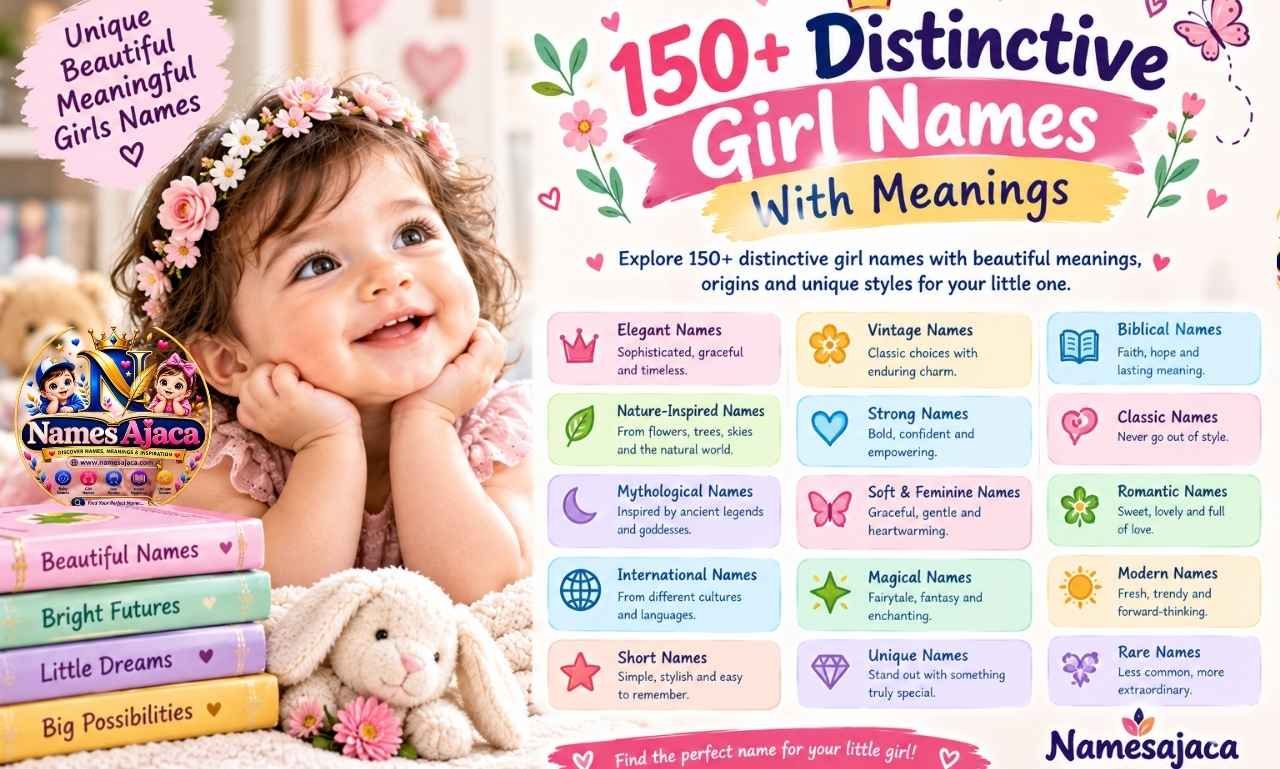
The names below are grouped by style and background. Some may be uncommon in the United States, while others may be more familiar depending on the year, state, or cultural community.
| Name | Meaning or documented association | Background |
| Amity | Friendship, harmony | English word name |
| Aurelia | Golden, gilded | Latin |
| Beatrix | Traditionally associated with blessedness; etymology has competing explanations | Latin-related form |
| Celeste | Heavenly, celestial | Latin/French |
| Eirlys | Snowdrop | Welsh |
| Elara | Etymology uncertain; associated with Greek mythology | Greek mythology |
| Eudora | Good gift | Greek |
| Felicity | Happiness, good fortune | Latin/English |
| Irene | Peace | Greek |
| Nadia | Often associated with “hope” through Slavic usage | Slavic |
| Paloma | Dove | Spanish |
| Serena | Serene, calm | Latin |
| Tova | Good | Hebrew/Scandinavian usage |
| Verity | Truth | English word name |
| Zinnia | Flower name | Botanical |
| Zora | Dawn | Slavic |
| Noemi | Form related to Naomi | Hebrew/European usage |
| Opal | Gemstone name | English word name |
| Pearl | Gemstone name | English word name |
| Wisteria | Flowering plant | Botanical |
| Adela | Noble | Germanic/European |
| Althea | Healing; Greek mythological name | Greek |
| Anwen | Very fair, beautiful | Welsh |
| Arwen | Fictional name from Tolkien’s legendarium | Literary |
| Astrid | Divine strength/beauty associations in Scandinavian naming traditions | Old Norse |
| Aveline | Mediaeval European name with uncertain deeper etymology | French/European |
| Briony | Climbing plant name | English/Botanical |
| Carys | Love | Welsh |
| Clarissa | Bright, clear | Latin-related |
| Elowen | Elm tree | Cornish |
| Estelle | Star | French/Latin |
| Linnea | Twinflower | Swedish/Botanical |
| Mireille | French form associated with admiration | French |
| Odette | French literary and historical name | French |
| Rosalie | Rose-related name | French/European |
| Sylvie | From Latin silva, forest | French |
| Violette | Violet flower | French |
| Acacia | Acacia tree | Botanical |
| Azalea | Flowering plant | Botanical |
| Clover | Clover plant | English word name |
| Fern | Fern plant | English word name |
| Flora | Flower: Roman goddess of flowers | Latin/Roman |
| Hazel | Hazel tree | English word name |
| Ivy | Ivy plant | English word name |
| Juniper | Evergreen plant | English word name |
| Laurel | Laurel tree | Latin/English |
| Magnolia | Flowering tree | Botanical |
| Meadow | Open grassland | English word name |
| Olive | Olive tree/fruit | English/Latin-related |
| Rowan | Rowan tree | English/Irish/Scottish usage |
| Willow | Willow tree | English word name |
| Aster | Star; also a flower name | Greek/Botanical |
| Dahlia | Flower named after Anders Dahl | Botanical |
| Iris | Rainbow; also a flower name | Greek |
| Lavender | Flowering plant | English word name |
| Marigold | Flower name | English |
| Primrose | First rose; flower name | English |
| Acacia | Tree name | Botanical |
| Calla | Flower-associated name | Botanical |
| Coral | Marine gemstone/reef material | English word name |
| Indigo | Colour name with plant association | English/Greek-related |
| Ocean | Nature/word name | English word name |
| Rain | Nature/word name | English word name |
| River | Nature/word name | English word name |
| Skye | Place name associated with the Isle of Skye | Scottish place name |
| Wren | Small bird name | English word name |
| Alba | Dawn/white associations depending on language | Romance/European |
| Alba | A European name with multiple linguistic uses | European |
| Anya | Common Slavic/Russian form related to Anna | Slavic |
| Chiara | Italian form related to Clara, “clear/bright” | Italian |
| Esme | French/English form with historical links to Old French | French/English |
| Freya | Norse goddess associated with love, beauty, and fertility | Old Norse mythology |
| Ines | European form related to Agnes | Spanish/Portuguese/European |
| Iona | Scottish island name | Scottish place name |
| Leona | Lion-related feminine form | Latin/European |
| Lucia | Light | Latin/Italian/Spanish |
| Noelle | Christmas-related French feminine form | French |
| Sienna | Place name associated with Siena | Italian place name |
| Talia | Multiple origins and uses; meaning varies by tradition | Multicultural |
| Valeria | Strong/healthy; feminine form of Valerius | Latin |
| Zahra | Flower/blossom; also associated with brightness in Arabic naming | Arabic |
| Zaria | Multiple possible linguistic associations | Multicultural |
| Elodie | French form with uncertain deeper etymology | French |
| Amara | Used in several languages with different meanings and origins | Multicultural |
| Amina | Trustworthy, faithful in Arabic usage | Arabic |
| Dalia | Used in several traditions, including flower-related usage | Multicultural |
| Hana | Different meanings depending on language and tradition | Multicultural |
| Inara | Used in Arabic naming; associated with illumination | Arabic |
| Liora | My light | Hebrew |
| Malika | Queen | Arabic |
| Mira | Multiple origins and meanings depending on language | Multicultural |
| Naya | Multiple linguistic origins and uses | Multicultural |
| Rania | Queen-like/queen in Arabic usage | Arabic |
| Samira | Evening companion in Arabic/Persian usage | Arabic/Persian |
| Soraya | Persian name associated with the Pleiades | Persian |
| Yasmin | Jasmine flower | Arabic/Persian |
| Zoya | Life | Slavic |
| Adira | Strong, powerful in Hebrew usage | Hebrew |
| Brielle | Modern feminine form related to Gabriel | French/English usage |
| Briar | Thorny plant/plant name | English word name |
| Emery | Germanic name associated with work/power | Germanic |
| Everly | English surname/place-name style | English |
| Harper | Harp player | English occupational surname |
| Lennox | Scottish surname/place name | Scottish |
| Marlowe | English surname/place-name style | English |
| Merritt | English surname/word name | English |
| Sutton | English place/surname name | English |
| Arden | English place/surname name; literary association | English |
| Bellamy | Beautiful friend | French/English surname |
| Hollis | Holly trees; English surname | English |
| Romilly | French/English surname and place-name usage | French/English |
| Winslet | English surname | English |
| Asteria | Greek mythological figure associated with stars | Greek mythology |
| Calypso | Sea nymph in Greek mythology | Greek mythology |
| Cassia | Cassia plant/spice; also an ancient name | Greek/Latin usage |
| Circe | Sorceress in Greek mythology | Greek mythology |
| Clio | Muse of history | Greek mythology |
| Daphne | Laurel: Greek mythological figure | Greek |
| Gaia | Earth; primordial deity in Greek mythology | Greek mythology |
| Helena | Greek/European name with ancient historical use | Greek |
| Ione | Greek mythological/literary name with violet association in some sources | Greek |
| Maia | Mythological name used in several traditions | Greek/Roman |
| Nyx | Primordial goddess/personification of night | Greek mythology |
| Rhea | Greek mythological figure | Greek mythology |
| Selene | Moon goddess in Greek mythology | Greek mythology |
| Thalia | One of the Muses; also used as a given name | Greek mythology |
| Theia | Greek Titan associated with sight and shining | Greek mythology |
| Ariadne | Greek mythological figure | Greek mythology |
| Andromeda | Greek mythological figure and constellation | Greek mythology |
| Electra | Greek mythological figure | Greek mythology |
| Elara | Greek mythological figure; etymology uncertain | Greek mythology |
| Eirene | Greek form associated with peace | Greek |
| Alina | Used across seven traditional settings. pean languages; meanings vary by tradition | European |
| Anouk | French/Dutch form related to Anna | French/Dutch |
| Beatriz | Romance-language form related to Beatrix | Spanish/Portuguese |
| Cosima | Feminine form related to Cosmas | Italian/European |
| Eleni | Greek form related to Helen | Greek |
| Ilaria | Italian form related to Hilary | Italian |
| Inga | Scandinavian/Germanic name | Scandinavian |
| Linnea | Twinflower | Swedish |
| Marisol | Spanish compound name associated with María de la Soledad | Spanish |
| Niamh | Bright/radiant in Irish tradition | Irish |
| Saoirse | Freedom | Irish |
| Tove | Scandinavian name with Old Norse roots | Scandinavian |
| Viveka | Scandinavian form related to Germanic names | Scandinavian |
| Zosia | Polish diminutive of Zofia | Polish |
| Eira | Snow | Welsh |
| Ffion | Foxglove | Welsh |
| Gwen | White/fair/blessed associations in Welsh naming | Welsh |
| Luned | Welsh legendary/literary name | Welsh |
| Nerys | Welsh given name | Welsh |
| Seren | Star | Welsh |
| Eleri | Welsh river/name tradition | Welsh |
| Aisling | Dream/vision | Irish |
| Caoimhe | Beautiful/gentle in Irish naming tradition | Irish |
| Clodagh | Irish river/name | Irish |
| Maeve | Anglicised form of Medb, an important figure in Irish mythology | Irish |
| Orla | Golden princess in Irish tradition | Irish |
| Róisín | Little Rose | Irish |
| Aoife | Irish traditional name associated with a warrior figure in mythology | Irish |
Distinctive Elegant Girl Names
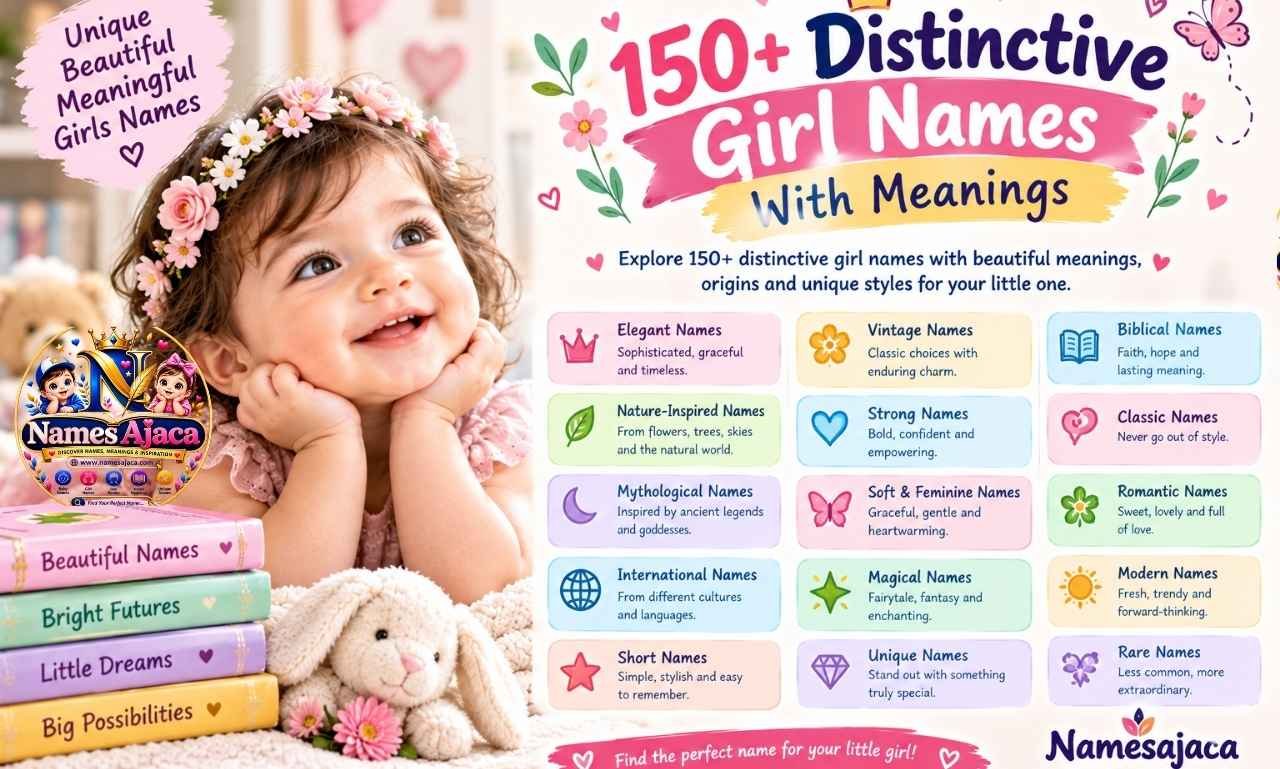
‘Elegant’ is a matter of style rather than an official name category. These names have different linguistic histories, but many have a polished, traditional, or refined sound:
- Aurelia
- Beatrix
- Celeste
- Clarissa
- Estelle
- Helena
- Lucia
- Rosalie
- Serena
- Valeria
- Vivienne
- Odette
- Sylvie
- Florence
- Genevieve
- Elodie
- Noelle
- Violette
- Cosima
- Ilaria
When choosing one, consider how it sounds with the family surname and whether its pronunciation will be intuitive where you live.
Distinctive Vintage Girl Names
Vintage names can feel fresh again when they return after spending years outside the mainstream.
Some possibilities include:
- Agnes
- Edith
- Florence
- Mabel
- Pearl
- Vera
- Winifred
- Clara
- Alice
- Esther
- Cora
- Beatrice
- Alma
- Elsie
- Lillian
- Opal
- Irene
- Sylvia
- Ruth
- Frances
A vintage name should not automatically be described as rare. Some traditional names have experienced significant revivals in the United States.
Distinctive Nature-Inspired Girl Names
Nature-inspired names include more than flowers. They can draw from botanical names, landscapes, colours, trees, animals, weather, or other elements of the natural world.
- Aster
- Azalea
- Clover
- Dahlia
- Fern
- Hazel
- Indigo
- Ivy
- Juniper
- Lavender
- Magnolia
- Meadow
- Olive
- Pearl
- Primrose
- Rain
- River
- Rowan
- Wisteria
- Willow
- Wren
- Coral
- Laurel
- Marigold
- Skye
These are nature-related naming styles, not a ranking of which names are statistically rare.
Distinctive Short Girl Names
Short names can be memorable without being complicated.
Consider:
- Alba
- Eira
- Esme
- Gaia
- Gwen
- Iona
- Iris
- Lumi
- Maia
- Mira
- Nia
- Opal
- Rhea
- Skye
- Tove
- Vera
- Wren
- Zora
- Zoya
- Cleo
Some of these names have multiple linguistic histories, so their pronunciation or meaning may vary by language.
Distinctive Mythological Girl Names
Mythological names have a long history of use in literature, religion, storytelling, and classical traditions. Their mythological association does not automatically make them statistically rare.
Some distinctive choices include:
- Ariadne
- Andromeda
- Asteria
- Calypso
- Circe
- Clio
- Daphne
- Gaia
- Helena
- Ione
- Maia
- Nyx
- Rhea
- Selene
- Thalia
- Theia
- Electra
- Elara
- Freya
- Arianrhod
Before choosing a mythological name, it can be helpful to read the original story or cultural context associated with it.
Distinctive International Girl Names
The names below come from different linguistic and cultural traditions, so pronunciation, meaning, and usage can vary by country.
Examples include:
- Amina
- Anya
- Chiara
- Hana
- Ilaria
- Linnea
- Marisol
- Niamh
- Noemi
- Paloma
- Saoirse
- Soraya
- Tove
- Yasmin
- Zahra
- Zosia
- Aoife
- Caoimhe
- Eira
- Ffion
An international name can be a beautiful choice, but parents should verify the spelling, pronunciation, and cultural context rather than relying on a simplified internet meaning.
Distinctive Girl Names With a Strong Style
A “strong” name does not necessarily mean that its literal translation is “strong”. Strength can also describe the sound, historical association, symbolism, or personality that parents connect with a name.
Some names with a strong style include:
- Adira
- Astrid
- Briar
- Freya
- Leona
- Valeria
- Victoria
- Matilda
- Asteria
- Andromeda
- Artemis
- Rhea
- Rowan
- Vera
- Zora
These are style-based suggestions rather than a claim that every name literally translates to “strength”.
Soft and Feminine Girl Names
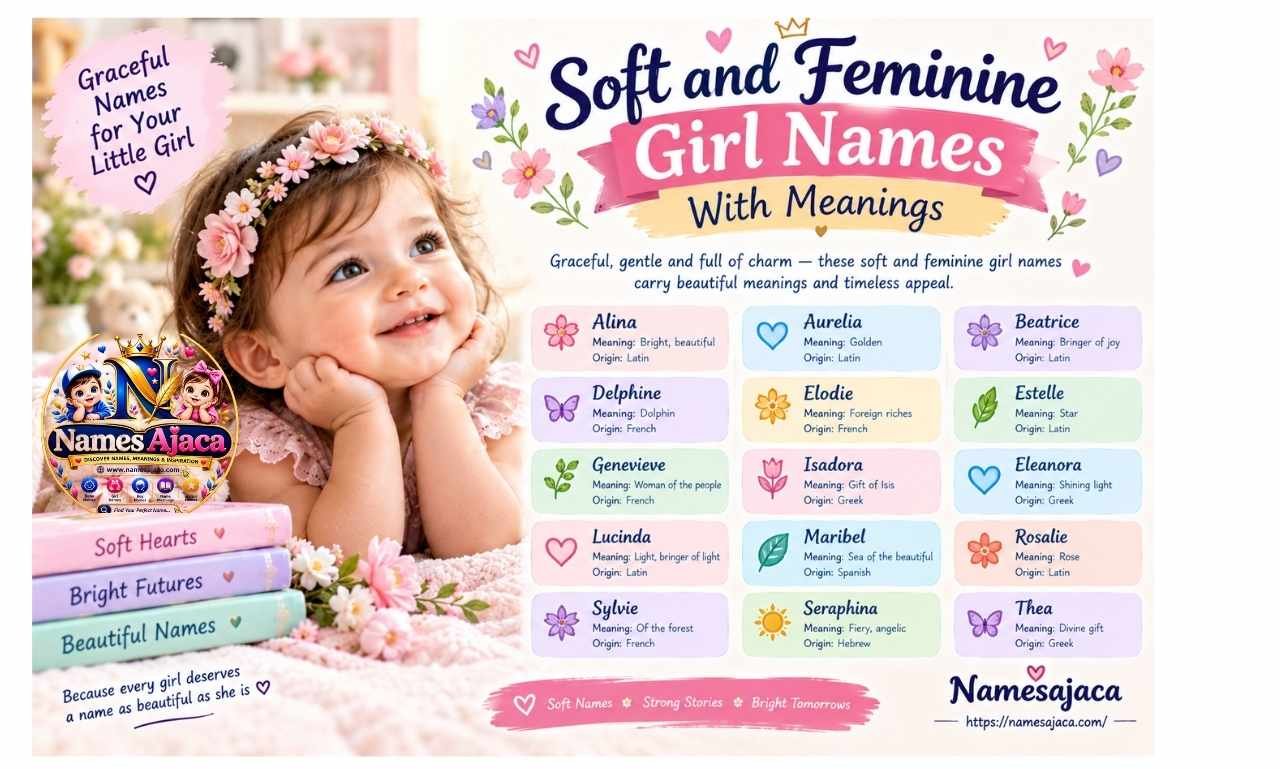
“Soft” and “feminine” describe naming style rather than objective linguistic categories.
Names that may have a gentle or traditionally feminine sound include:
- Amelie
- Celeste
- Elodie
- Estelle
- Liora
- Rosalie
- Sylvie
- Noelle
- Violette
- Aurelia
- Serena
- Lucia
- Mira
- Amara
- Carys
- Eira
- Linnea
- Anwen
- Eleni
- Iona
The perception of a name can vary considerably between languages and cultures.
Girl Names With a Magical Feel
A magical or fantasy-style association is subjective. A name can feel magical because of mythology, literature, nature, sound, or cultural associations.
Some possibilities include:
- Elara
- Asteria
- Calypso
- Selene
- Lyra
- Celeste
- Fae
- Luna
- Rhea
- Ariadne
- Elowen
- Seren
- Wisteria
- Opal
- Eira
- Freya
- Nyx
- Thalia
- Ione
- Aveline
These names are suggestions for a particular aesthetic rather than a factual classification.
Distinctive Girl Names With Relatively Simple English Pronunciations
No pronunciation is objectively easy for everyone. A name that feels straightforward to one speaker may be unfamiliar to another.
Still, these names generally have relatively simple English pronunciations:
| Name | Common English pronunciation |
| Clara | CLAIR – uh |
| Cora | KOR-uh |
| Daphne | DAF-nee |
| Elara | eh-LAR-uh |
| Hazel | HAY-zul |
| Iris | Eye-rising |
| Iona | eye-OH-nuh |
| Lucia | loo-SEE-uh or loo-CHEE-uh |
| Nadia | NAH-dee-uh |
| Paloma | puh-LOH-muh |
| Serena | suh-REE-nuh |
| Serena | suh-REE-nuh |
| Vera | VEER-uh or VAIR-uh |
| Zinnia | ZIN-ee-uh |
| Zora | ZOR-uh |
Vera is a good example of regional variation. Both VEER-uh and VAIR-uh are used in English-speaking contexts.
If pronunciation is important to you, saying the name aloud with the surname is one of the easiest ways to test whether it feels natural.
Distinctive Girl Names That Balance Uncommon and Usable
Some parents want a name that stands out without requiring constant explanation. The following is a style-based shortlist rather than an official ranking:
- Celeste
- Clara
- Cora
- Elara
- Elowen
- Estelle
- Iris
- Iona
- Linnea
- Nadia
- Paloma
- Serena
- Sylvie
- Vera
- Wren
- Zora
- Aurelia
- Beatrix
- Rosalie
- Noelle
The best choice depends on your surname, family background, preferred pronunciation, and how familiar the name is in your local community.
How to Choose a Distinctive Girl Name
Choosing an uncommon name does not have to mean choosing the most unusual option available.
1. Decide how distinctive you want the name to feel.
Ask yourself whether you want:
- Familiar but less common
- Vintage
- Nature-inspired
- Mythological
- International
- Short and simple
- Elegant
- Strong
- Whimsical
This makes a large list much easier to narrow down.
2. Check the actual U.S. popularity.
A name that feels rare may not be statistically rare.
The Social Security Administration’s Popular Baby Names database can help you check popularity by birth year. Its state-level data can also show how naming patterns differ between locations.
3. Say the complete name aloud.
Test the first name with the surname and any planned middle name.
Pay attention to:
- Repeated sounds
- Initials
- Number of syllables
- Natural pronunciation
- Possible nicknames
4. Check spelling and pronunciation
If you choose a name from another language, research how it is traditionally pronounced and spelt.
Avoid changing a name’s spelling simply to make it appear more unique unless you are comfortable explaining the spelling repeatedly.
5. Research the cultural background
An established name from another culture can have a much richer history than a simplified “baby-name meaning” suggests.
Check reliable sources before assuming a name has one universal meaning.
Rare vs. Unique vs. Uncommon Girl Names
These terms overlap, but they are not identical.
‘Rare’ usually suggests relatively infrequent use.
‘Uncommon’ generally means a name is not encountered often in a particular population or setting.
‘Distinctive’ describes a name that stands out from surrounding choices.
‘Unique’ literally means ‘one of a kind’, but in everyday baby-name discussions it usually means ‘distinctive’ or ‘unusual’. It does not literally mean that nobody else has the name.
A name’s actual rarity depends on the population, location, spelling, and time period being considered.
For example, a name may be uncommon nationally but familiar in a particular state or cultural community.
How Rare Is Too Rare?
There is no universal point at which a name becomes “too rare”. The answer depends on what you want from the name.
If you want a name that is distinctive but still easy to recognise, look for an established name with relatively limited current use.
If you are comfortable with a name that requires occasional pronunciation or spelling explanations, you can consider more unusual options.
The SSA provides an important perspective on U.S. naming frequency. In 2025, the SSA’s Top 1,000 girl names accounted for 67.25% of female births represented in its data. That means a substantial share of girls received names outside the Top 1,000.
The SSA also provides national and state-specific name data, which can be useful when comparing naming patterns across locations.
How to Check a Girl Name’s Popularity
For U.S. baby-name research, the Social Security Administration is one of the most useful starting points.
You can use the database to:
- Search a name by birth year.
- Compare popularity across different years. judgement
- Examine state-level popularity.
- Look at changes in ranking.
- Determine whether a name appears in the current Top 1,000.
SSA’s public baby-name information is based on Social Security card application data. The searchable historical data extend back to 1880, giving parents a long-term view of how names have changed over time.
Remember that a ranking is not the same thing as a judgement about whether a name is good, beautiful, modern, or distinctive. Popularity is simply one piece of information to consider.
Rare Girl Names by Style
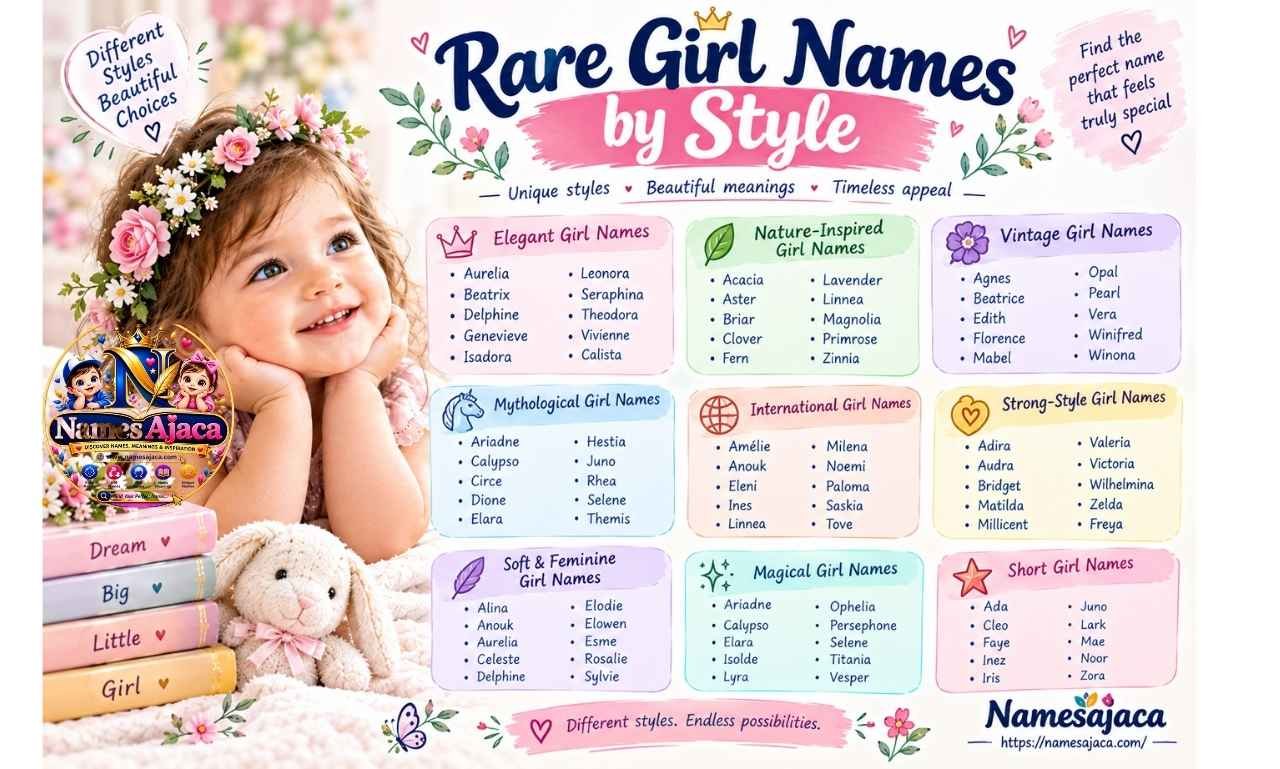
If you want to narrow your search quickly, use the style that best matches your preferences:
| Style | Names to Explore |
| Elegant | Aurelia, Celeste, Estelle, Serena |
| Vintage | Agnes, Edith, Florence, Mabel |
| Nature | Hazel, Ivy, Willow, Wren |
| Botanical | Aster, Dahlia, Iris, Zinnia |
| Mythological | Ariadne, Calypso, Daphne, Selene |
| International | Chiara, Niamh, Paloma, Zahra |
| Short | Eira, Iris, Mira, Zora |
| Strong style | Adira, Astrid, Freya, Valeria |
| Soft style | Elodie, Rosalie, Sylvie, Noelle |
| Magical style | Elara, Asteria, Selene, Elowen |
This table describes style and association, not official popularity categories.
Interesting Facts About Distinctive Girl Names
- A name can be uncommon nationally but relatively familiar in one state.
- Spelling variations can affect how often a particular form appears in baby-name data.
- A name’s popularity can change significantly over a few years.
- Historical names can return to use after decades of lower popularity.
- Mythological names are not automatically rare.
- Nature names can include flowers, trees, landscapes, colours, animals, and other natural associations.
- “Unique” does not literally mean that only one person has a name.
- Pronunciation can change between languages and regions.
- Some names have multiple proposed etymologies.
- A name’s meaning may vary depending on its linguistic tradition.
Frequently Asked Questions
What is considered a rare girl name?
There is no universal statistical definition of a rare girl name. In everyday naming discussions, the term generally refers to names that are relatively uncommon or unfamiliar within a particular population.
What is the prettiest rare girl name?
There is no objectively prettiest name. Names such as Aurelia, Celeste, Elodie, Rosalie, and Serena may appeal to parents who prefer an elegant sound, while nature or mythological names offer different styles.
What are some rare girl names that are easy to pronounce?
Names such as Clara, Cora, Daphne, Hazel, Iris, Nadia, Serena, and Zora have relatively straightforward English pronunciations for many speakers. Individual pronunciation preferences can still vary.
What are some rare vintage girl names?
Agnes, Edith, Florence, Mabel, Pearl, Vera, Winifred, and Frances have historical use and a vintage style. Their current popularity can vary, so check recent SSA data if U.S. frequency matters to you.
What are some rare nature-inspired girl names?
Aster, Clover, Fern, Hazel, Ivy, Juniper, Meadow, Willow, Wren, and Zinnia are examples of nature-related naming styles.
Are mythological girl names rare?
Not necessarily. Mythological names can range from very familiar to relatively uncommon. Mythological origin and statistical rarity are separate characteristics.
How can I check whether a girl name is actually rare in the U.S.?
Use the Social Security Administration’s baby-name database. You can check a name by year and also compare state-level data.
Is a unique name the same as a rare name?
No. “Unique” literally means one of a kind, although it is commonly used to mean distinctive or unusual. “Rare” generally refers to relatively infrequent use.
Can a name be rare in one state but common in another?
Yes. Naming patterns vary by location, so a name’s national frequency does not always reflect its popularity within an individual state.
Should I choose a rare spelling of a common name?
That depends on your priorities. A less common spelling can make a name look distinctive, but it may also lead to more spelling corrections or pronunciation questions.
How important is a name’s meaning?
Meaning can be an important part of choosing a name, but it should be researched carefully. Some popular baby-name websites simplify or disagree about etymology, so established linguistic or historical sources are preferable when accuracy matters.
Final Thoughts
Choosing among rare cute girl names is not simply about finding the least common name possible. The best choice may be an established name that feels distinctive, sounds natural with your surname, has a meaningful background, and works well in everyday life.
Remember that “rare” is a broad descriptive term rather than an official statistical category. For parents choosing a name in the United States, current SSA data can help separate a name’s subjective impression from its actual popularity.
Whether you prefer an elegant vintage name, a botanical choice, a mythological option, an international name, or a short and simple favourite, focus on the qualities that matter most to your family.
For more baby-name inspiration, meanings, and naming guides, explore Namesajaca.com for more helpful name collections.
1 thought on “Rare Girl Names: 150+ Unique, Beautiful & Meaningful Ideas”