Choosing a baby boy’s name is a big decision. Some parents want something modern and distinctive, while others prefer a name with a long history that still sounds natural today.
That’s where classic boy names stand out. Names such as James, William, Henry, Alexander, Benjamin, Charles, and Theodore have strong historical connections and remain familiar to English-speaking families.
But “classic” does not necessarily mean “old-fashioned”, and it does not automatically mean “popular”. A classic name can be widely used today, moderately common, or relatively uncommon.
In this guide, you’ll find 100 classic boy names with their traditional meanings or background, origins, short forms, historical context, and practical tips for choosing the right name.
Note: “Classic” is a style description, not an official baby-name category. Name meanings can also vary because some names have disputed or multiple etymologies. Where the history is uncertain, this guide uses cautious wording rather than presenting one theory as fact.
100 Classic Boy Names With Meanings and Origins
| # | Name | Meaning / Background | Origin | Nicknames / Short Forms |
| 1 | Aaron | Biblical name with an uncertain original meaning | Hebrew | Ari |
| 2 | Adam | “Man” or “human”; traditionally connected with adamah, “ground” | Hebrew | Ad, Addy |
| 3 | Albert | “Noble” + “bright” or “famous” | Germanic | Al, Bert, Albie |
| 4 | Alexander | Traditionally interpreted as “defender of men” | Greek | Alex, Alec, Xander |
| 5 | Alfred | Traditionally interpreted as “elf counsel” | Old English | Alf, Freddie |
| 6 | Andrew | “Manly” or “brave” | Greek | Andy, Drew |
| 7 | Anthony | English form of the Roman family name Antonius; original etymology is uncertain | Latin/Roman | Tony, Ant |
| 8 | Arthur | Historic British name with uncertain etymology; several theories have been proposed. | British/Celtic | Art, Artie |
| 9 | Benjamin | Traditionally interpreted as “son of the right hand” or “son of the south” | Hebrew | Ben, Benny, Benji |
| 10 | Caleb | Traditionally associated with faithfulness or wholeheartedness | Hebrew | Cal |
| 11 | Calvin | Traditionally linked with Latin calvus, “bald” | French/Latin | Cal |
| 12 | Carl | Germanic form related to Charles; traditionally associated with “free man” | Germanic | Carl |
| 13 | Charles | Traditionally interpreted as “free man” | Germanic | Charlie, Chuck |
| 14 | Christian | “Christian” or “follower of Christ” | Greek/Latin | Chris |
| 15 | Christophe forms | Traditionally interpreted as “Christ-bearer” | Greek | Chris, Kit |
| 16 | Colin | English and Scottish forms with historical connections to Nicholas | English/Scottish | Col |
| 17 | Daniel | “God is my judge.” | Hebrew | Dan, Danny |
| 18 | David | Traditionally interpreted as “beloved” | Hebrew | Dave, Davy |
| 19 | Dominic | “Of the Lord” | Latin | Dom, Nico |
| 20 | Douglas | Scottish surname/place-name traditionally associated with “dark river” | Scottish Gaelic | Doug |
| 21 | Duncan | Scottish Gaelic name with elements traditionally associated with “brown” and “battle” | Scottish Gaelic | Dun |
| 22 | Edmund | Traditionally associated with “prosperity” and “protection” | Old English | Ed, Eddie |
| 23 | Edward | “Wealth/prosperity” + “guardian” | Old English | Ed, Eddie, Ted |
| 24 | Edwin | Traditionally interpreted from elements meaning “rich” and “friend” | Old English | Ed, Eddie |
| 25 | Elijah | “My God is Yahweh.” | Hebrew | Eli |
| 26 | Elliott | English surname/given-name form related to Elias or Elijah | English | Eli, El |
| 27 | Eric | Traditionally interpreted as “ever ruler” or “eternal ruler” | Old Norse | Erik |
| 28 | Ethan | “Strong”, “firm”, or “enduring” | Hebrew | Ean |
| 29 | Evan | Welsh form of John; ultimately associated with “Yahweh is gracious” | Welsh/Hebrew | Ev |
| 30 | Felix | “Lucky” or “fortunate” | Latin | Felix |
| 31 | Francis | Traditionally associated with “Frenchman” or “Frankish” | Latin | Frank, Frankie |
| 32 | Frederick | “Peaceful ruler” | Germanic | Fred, Freddie |
| 33 | George | “Farmer” or “earthworker” | Greek | Georgie |
| 34 | Graham | Scottish surname/place name with a complex historical origin | Scottish/English | Grey |
| 35 | Grant | Surname traditionally associated with “great” or “large” in one interpretation | Scottish/English | Grant |
| 36 | Gregory | “Watchful” or “vigilant” | Greek | Greg |
| 37 | Harold | Traditionally interpreted as “army ruler” | Old Norse/Old English | Harry, Hal |
| 38 | Harry | Mediaeval English form related to Henry | English | Hal |
| 39 | Harvey | Breton name traditionally associated with elements meaning “battle” and “iron” | Breton | Harv |
| 40 | Hector | Traditionally associated with “holding fast” or “steadfast” | Greek | Hector |
| 41 | Henry | “Home ruler” | Germanic | Hank, Harry |
| 42 | Hugh | Traditionally associated with “mind”, “heart”, or “spirit” | Germanic | Hugh |
| 43 | Ian | Scottish form of John; ultimately related to Hebrew Yohanan | Scottish/Hebrew | Ian |
| 44 | Isaac | “He will laugh” or “he will rejoice.” | Hebrew | Ike |
| 45 | Jack | Mediaeval English form or diminutive of John | English | Jackie |
| 46 | James | English form ultimately related to Jacob through historical Latin forms | Hebrew/English | James, Jamie, Jim |
| 47 | John | “Yahweh is gracious,” he adds. | Hebrew | Johnny |
| 48 | Joseph | “He will add.” | Hebrew | Joe, Joey |
| 49 | Julian | Roman name derived from Iulianus; the ultimate meaning of Julius is uncertain. | Latin/Roman | Jules |
| 50 | Julius | Roman family name; ultimate meaning is uncertain | Latin/Roman | Jules |
| 51 | Kenneth | Scottish Gaelic name with more than one proposed etymology | Scottish Gaelic | Ken, Kenny |
| 52 | Lawrence | From Roman Laurentius, associated with Laurentum | Latin | Larry, Laurie |
| 53 | Lewis | English form related to Louis | Germanic/French/English | Lew |
| 54 | Liam | Short form of William | Irish/English | Liam |
| 55 | Louis | Traditionally associated with Germanic elements meaning “famous” and “battle” | Germanic/French | Lou, Louie |
| 56 | Lucas | Greek/Latin | Luke, Luca | |
| 57 | Marcus | Roman name probably associated with Mars | Latin/Roman | Mark |
| 58 | Martin | From Martinus, traditionally associated with Mars | Latin | Marty |
| 59 | Matthew | “Gift of Yahweh” | Hebrew | Matt, Matty |
| 60 | Maxwell | Scottish surname/place name with a complex historical origin | Scottish | Max |
| 61 | Michael | “Who is like God?” | Hebrew | Mike, Mikey |
| 62 | Miles | Has several possible linguistic histories; ultimate origin is uncertain | English/European | Milo |
| 63 | Morris | English form related to Maurice | Latin/English | Mo, Morrie |
| 64 | Nathan | Traditionally associated with “he gave” or “gift” | Hebrew | Nate |
| 65 | Nathaniel | “Gift of God” | Hebrew | Nate, Nat |
| 66 | Neil | Gaelic name with a disputed traditional meaning | Irish/Scottish Gaelic | Neal |
| 67 | Nicholas | “Victory of the people” | Greek | Nick, Nico |
| 68 | Oliver | From Old French Olivier; possibly connected with Latin oliva, “olive tree”, though other theories exist | French/European | Ollie, Olly |
| 69 | Oscar | Etymology is disputed; one traditional interpretation connects it with “deer friend”. | Irish/Old Norse | Oz, Ozzie |
| 70 | Owen | The English form of Welsh Owain; exact etymology is uncertain | Welsh/English | Owie |
| 71 | Paul | “Small” or “humble” | Latin | Paulie |
| 72 | Peter | “Rock” or “stone” | Greek | Pete |
| 73 | Philip | “Lover of horses” | Greek | Phil |
| 74 | Raymond | “Wise protection” or “counsel + protection” | Germanic | Ray |
| 75 | Reginald | Traditionally associated with “ruler’s counsel” | Germanic | Reg, Reggie |
| 76 | Richard | “Brave ruler” | Germanic | Rich, Rick, Richie |
| 77 | Robert | “Bright fame” | Germanic | Rob, Bob, Robbie |
| 78 | Roland | Traditionally associated with “fame” and “land” | Germanic | Roly |
| 79 | Russell | Surname traditionally associated with reddish hair or complexion | French/English | Russ |
| 80 | Samuel | Traditionally interpreted as “God has heard” | Hebrew | Sam, Sammy |
| 81 | Scott | Originally a surname referring to a person from Scotland | Scottish/English | Scot |
| 82 | Simon | Traditionally interpreted as “he has heard” in its Hebrew form | Hebrew/Greek | Si |
| 83 | Spencer | Occupational surname associated with a steward or administrator | English | Spence |
| 84 | Stephen | “Crown” or “wreath” | Greek | Steve, Stevie |
| 85 | Stuart | Scottish surname connected with the office of steward | Scottish/English | Stu |
| 86 | Theodore | “Gift of God” | Greek | Theo, Ted, Teddy |
| 87 | Thomas | “Twin” | Aramaic | Tom, Tommy |
| 88 | Timothy | “Honouring God” | Greek | Tim, Timmy |
| 89 | Victor | “Victor” or “conqueror” | Latin | Vic |
| 90 | Vincent | Traditionally associated with “conquering” or “prevailing” | Latin | Vince, Vinny |
| 91 | Walter | Germanic name formed from elements associated with rule and the army | Germanic | Walt |
| 92 | Wesley | English surname/place-name associated with a “western clearing” | Old English | Wes |
| 93 | William | “Will/desire” + “helmet/protection” | Germanic | Will, Bill, Billy |
| 94 | Winston | English surname/place-name with Old English roots | Old English | Win |
| 95 | Cecil | From the Roman family name Caecilius, traditionally connected with Latin caecus, “blind” | Latin/Roman | Cec |
| 96 | Clarence | From a Roman family name and later an English title; associated with “clear” or “bright” | Latin/English | Clare |
| 97 | Conrad | “Brave counsel” | Germanic | Con |
| 98 | Leonard | Traditionally interpreted as “brave lion” | Germanic | Leo, Lenny |
| 99 | Malcolm | The Scottish Gaelic name is traditionally interpreted as “disciple of Columba”. | Scottish Gaelic | Mal |
| 100 | Maurice | From Latin Maurus, traditionally associated with “Moorish” or “dark-skinned” | Latin | Maury, Mo |
What Makes a Boy Name Classic?
A classic boy name usually has a long history of recognisable use and remains familiar across generations.
Classic names can come from many naming traditions, including:
- Biblical names
- Greek and Roman names
- Germanic names
- Old English names
- Mediaeval English names
- Welsh and Gaelic traditions
- Royal and historical naming traditions
- Surnames that became established as first names
However, ‘classic’ does not mean the same thing as ‘popular’.
A name may have centuries of history but have relatively little current use. Another name may be extremely popular today but have a more recent history.
For this reason, it is useful to separate these terms:
Classic: A name with established historical or cultural use.
Popular: A name currently used frequently in a particular population or year.
Vintage: A name that strongly evokes an earlier period or generation.
Timeless: A subjective description for a name that continues to feel appealing despite changing trends.
Uncommon: A name that has relatively low current usage compared with more frequently chosen names.
Popular Classic Boy Names in the United States
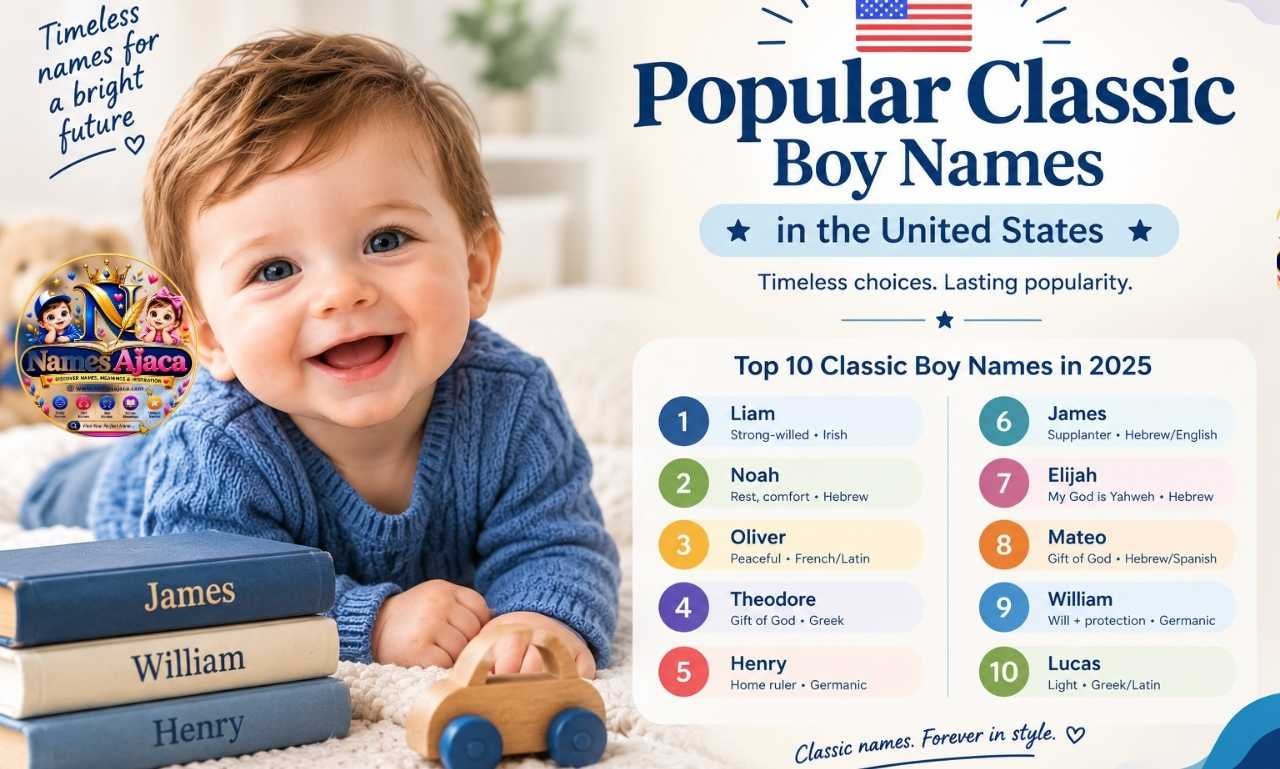
Classic names continue to appear among highly ranked U.S. baby names.
According to the Social Security Administration’s 2025 national baby-name rankings, Liam, Noah, Oliver, Theodore, Henry, James, Elijah, Mateo, William, and Lucas were the top 10 boys’ names in the United States.
Several of these names, including Oliver, Theodore, Henry, James, William, and Lucas, can reasonably be described as classic or traditional in style because they have established histories beyond their current popularity.
It is important, however, not to confuse an SSA ranking with a “classic” classification. The SSA measures name usage; it does not officially label names as classic.
Classic Boy Names With Great Nicknames
One advantage of traditional names is that many offer flexible short forms.
Alexander
Alex, Alec, Xander
Benjamin
Ben, Benny, Benji
Christopher
Chris, Kit
Daniel
Dan, Danny
Edward
Ed, Eddie, Ted
Frederick
Fred, Freddie
Henry
Hank, Harry
Joseph
Joe, Joey
Michael
Mike, Mikey
Nathaniel
Nate, Nat
Nicholas
Nick, Nico
Theodore
Theo, Ted, Teddy
William
Will, Bill, Billy
A formal name with several established short forms can give parents flexibility. You can use the full name in formal situations while choosing a shorter form for everyday life.
Classic Boy Names With Historical Connections
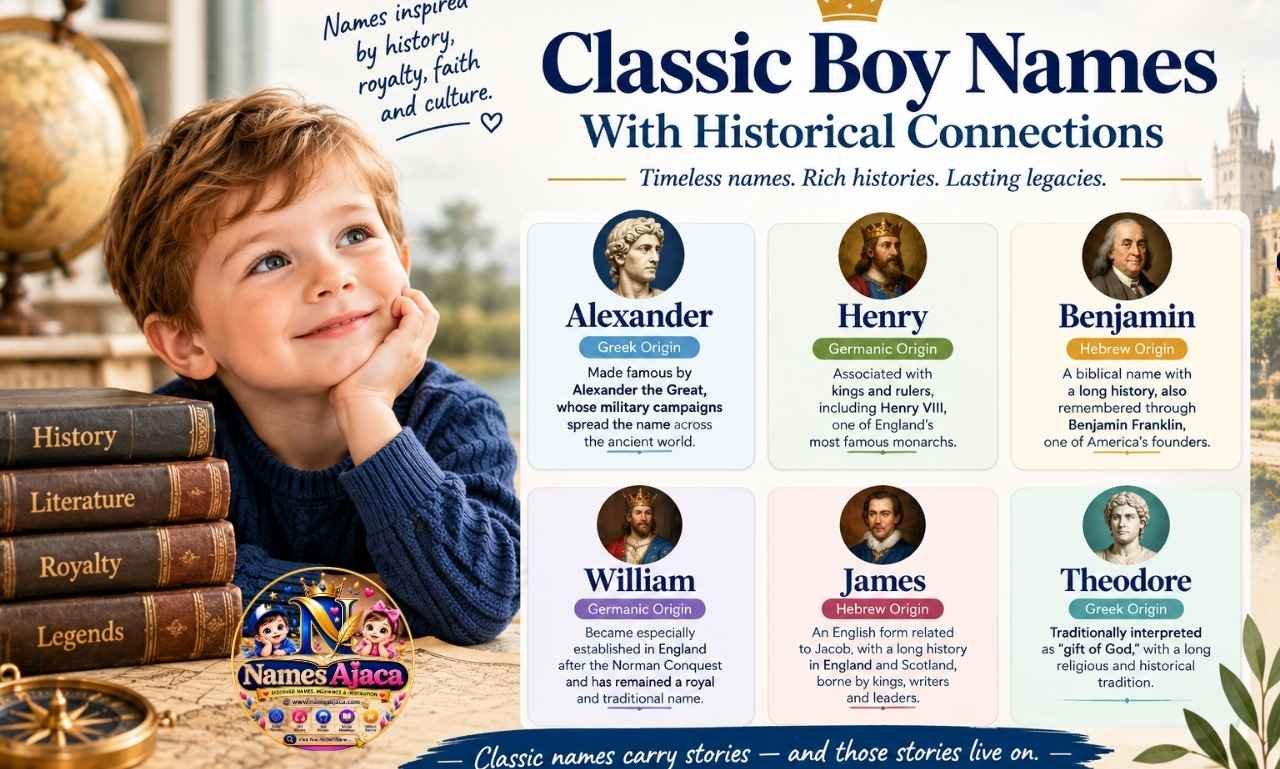
Many traditional names became familiar through centuries of religious, royal, literary, political, and cultural history.
Alexander
Alexander is a Greek name traditionally interpreted as “defender of men”. Its historical prominence was strongly influenced by Alexander the Great, whose military campaigns helped spread the name’s fame across a large part of the ancient world.
Benjamin
Benjamin is a biblical name with a long history. The name is associated with the youngest son of Jacob in the Hebrew Bible. In modern American history, Benjamin Franklin is another famous bearer.
William
William comes from Germanic elements traditionally associated with will or desire and protection. It became especially established in England after the Norman Conquest and has remained strongly associated with English history and royalty.
James
James is an English form historically related to Jacob through Latin forms. It has been used for centuries in England and Scotland and has been borne by kings, writers, religious figures, and political leaders.
Theodore
Theodore comes from Greek and is traditionally interpreted as “gift of God”. The name has a long religious and historical tradition and has also been used by notable modern figures.
Classic Biblical Boy Names
Biblical names are one of the strongest sources of traditional boy names.
Some classic choices include:
- Adam — traditionally connected with “man” or “human”
- Aaron — biblical name with uncertain original meaning
- Benjamin — traditionally associated with the “right hand” or “south”
- Daniel — “God is my judge”
- David — traditionally interpreted as “beloved”
- Elijah — “My God is Yahweh”
- Isaac — “He will laugh” or “He will rejoice.”
- Joseph — “He will add.”
- Matthew — “gift of Yahweh”
- Michael — “Who is like God?”
- Nathan — traditionally associated with “he gave”
- Samuel — traditionally interpreted as “God has heard”
If a name’s religious meaning is especially important to you, it is worth checking the original language and historical form rather than relying only on simplified baby-name lists.
Classic Irish, Scottish, Welsh & Celtic- Connected Boy Names
Not every Scottish or Welsh-associated name has a purely Celtic etymology. Some became associated with these regions through surnames, place names, historical families, or local usage.
Scottish and Gaelic Connections
- Duncan
- Douglas
- Kenneth
- Malcolm
- Stuart
- Graham
- Scott
- Maxwell
Welsh Connections
- Owen
- Evan
Irish Connections
- Liam
- Neil
This distinction is useful because regional association and linguistic origin are not always the same thing.
For example, Scott originated as a surname referring to a person from Scotland, while Stuart is connected with the occupation of steward. They are strongly associated with Scottish history, but that does not make every element of their etymology Celtic.
Classic Boy Names That Feel Modern
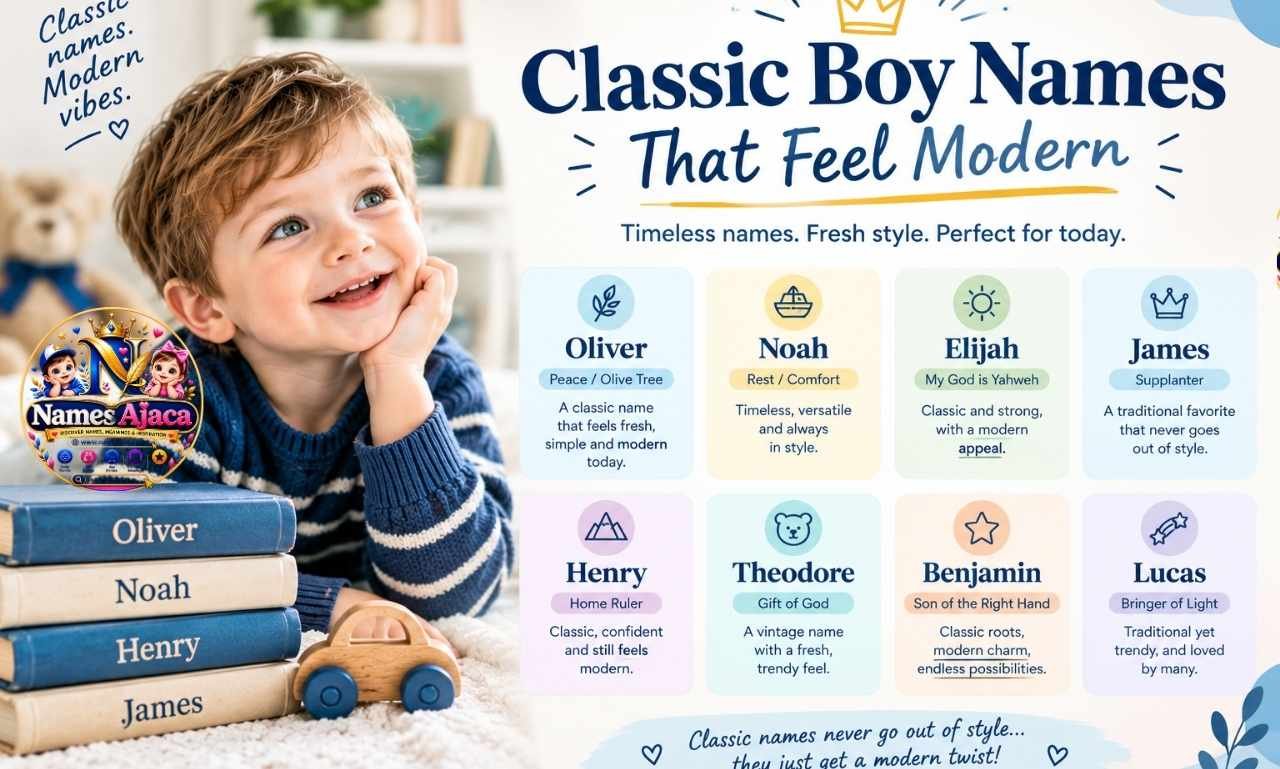
A classic name does not have to sound old-fashioned.
Names such as:
- Oliver
- Theodore
- Henry
- James
- William
- Lucas
- Alexander
- Benjamin
- Liam
- Ethan
can combine historical roots with a contemporary feel.
Short forms can make traditional names feel even more casual:
- Theodore → Theo
- Alexander → Alex
- Benjamin → Ben
- William → Will
- Nicholas → Nick
- Frederick → Freddie
- Nathaniel → Nate
- Christopher → Chris
The important point is that “modern” is a matter of current style and perception, not necessarily the age of a name.
Classic Boy Names That May Feel Less Common
Current popularity changes from year to year, so it is safer to say that some names may feel less common rather than labelling them permanently uncommon.
Examples include:
- Conrad
- Clarence
- Cecil
- Leonard
- Malcolm
- Reginald
- Raymond
- Roland
- Maurice
- Hugh
These names can provide a traditional style without automatically choosing one of the most visible names of the current year.
If current popularity matters to you, check the latest Social Security Administration rankings before making a final decision.
Classic vs. Vintage vs. Timeless
These terms are often used together, but they describe different ideas.
Classic
A classic name has a long-established history and remains recognisable across generations.
Examples include:
James, William, Charles, Alexander, and Joseph.
Vintage
A vintage name often reminds people of an earlier generation or historical period.
Examples might include:
Cecil, Clarence, Reginald, and Maurice.
Timeless
Timeless is more subjective. It describes a name that continues to feel appropriate or attractive despite changing naming trends.
A name can therefore be classic without being highly popular today.
How to Choose the Right Classic Boy Name
Once you have a shortlist, use these simple tests.
1. Say the full name aloud.
Say the first, middle, and last names together. Listen to the rhythm and pronunciation.
2. Consider the Nickname
If the name has common short forms, decide whether you like them.
For example:
William → Will, Bill, Billy
If you strongly dislike one of the established forms, consider whether that could become an issue later.
3. Check the Meaning
If meaning is important to you, verify the name’s history using a reliable etymological source.
4. Think About Initials
Write the initials with the first, middle, and last names. Make sure they do not create an unwanted abbreviation.
5. Consider Popularity
If you want a highly recognisable name, a current top-ranked choice may work well.
If you want something more distinctive, look beyond the current top names.
6. Think Long-Term
Imagine the name on:
- A birth announcement
- A school roster
- A graduation certificate
- A résumé
- A professional email address
A name that works comfortably across different stages of life can be a strong choice.
Classic Boy Names by Style
Traditional and Formal
- Alexander
- Benjamin
- Charles
- Edward
- Frederick
- Henry
- Theodore
- William
Short and Strong
- Jack
- John
- Hugh
- Paul
- Peter
- Mark
- Grant
- Luke
Biblical
- Aaron
- Adam
- Daniel
- David
- Elijah
- Isaac
- Joseph
- Samuel
Royal and Historical
- Charles
- Edward
- George
- Henry
- James
- Louis
- William
- Alexander
Vintage-Feeling
- Cecil
- Clarence
- Edmund
- Maurice
- Reginald
- Roland
- Winston
- Alfred
How Reliable Is Baby Name? Meanings Online?
Baby-name meanings are not always as simple as a one-word definition suggests.
Some names have:
- Multiple proposed origins
- Uncertain ancient roots
- Different forms in different languages
- Changes in spelling over centuries
- Later folk interpretations
- Meanings that became associated with a name after its original formation
For example, Arthur has an uncertain etymology, with several theories proposed for its origin.
Anthony comes from the Roman family name Antonius, whose deeper origin is uncertain.
Oliver has more than one proposed etymological explanation.
Miles also has several possible linguistic histories.
This is why a trustworthy name guide should distinguish between an established meaning and a proposed or traditional interpretation.
Interesting Facts About Classic Boy Names
1. William Has a Long English History
William became especially established in England after the Norman period and has remained an important traditional name.
2. James Has Multiple Historical Forms
James developed through historical forms related to Jacob, demonstrating how names can change significantly as they move between languages.
3. Oliver Has a Complicated Etymology
Oliver is commonly associated with the olive tree through Latin oliva, but other theories have also been proposed. Its history is therefore more complicated than simply saying “Oliver means olive tree.”
4. Arthur’s Meaning Is Not Certain
Arthur is one of the best-known names associated with British legend, but its exact linguistic origin remains uncertain.
5. Classic Does Not Mean Unchanging
A name can remain classic while its popularity rises and falls. This is one reason historical popularity data can be useful when choosing a traditional name.
Are Classic Boy Names Still Popular?
Yes. Many traditional names remain highly visible in modern U.S. naming data.
The Social Security Administration’s 2025 national rankings placed several traditional names among the country’s most-used boys’ names, including:
- Oliver
- Theodore
- Henry
- James
- William
- Lucas
This shows why it is useful to separate classic style from current popularity.
A name can be both classic and highly popular, while another classic name may be much less frequently chosen.
For parents who want a traditional name but do not want one of the current leaders, checking the latest annual rankings can help narrow the options.
Frequently Asked Questions
What are the most classic boy names?
Some widely recognised classic choices include James, William, Henry, Charles, Alexander, Benjamin, Edward, George, Joseph, Michael, Thomas, and Theodore.
There is no official list of “the most classic” names because classic status is partly based on historical use and cultural perception.
What classic boy names are popular in 2025?
According to the Social Security Administration’s 2025 U.S. rankings, Oliver, Theodore, Henry, James, William, and Lucas were among the top 10 boys’ names nationally.
What classic boy names may feel less common?
Names such as Conrad, Cecil, Clarence, Leonard, Malcolm, Maurice, Raymond, Reginald, and Roland may give a more distinctive traditional impression.
However, “less common” should not be treated as a permanent ranking. Baby-name popularity changes over time.
Are classic boy names old-fashioned?
Not necessarily. Many classic names are currently popular and can feel modern depending on the name, pronunciation, nickname, and family combination.
What is the difference between classic and timeless?
“Classic” generally refers to established historical or cultural use. “Timeless” is more subjective and describes a name that continues to feel appealing despite changing trends.
Are classic names more popular than modern names?
Not necessarily. “Classic” describes style and history, while “popular” describes current usage. A classic name can be highly popular, moderately popular, or relatively uncommon.
How should I choose between two classic boy names?
Compare their pronunciation, meaning, nickname options, initials, popularity, historical associations, and how naturally each name sounds with your surname.
Final Thoughts
Classic boy names offer something many parents value: a strong connection to history without necessarily feeling outdated.
Names such as James, William, Henry, Alexander, Benjamin, Theodore, Oliver, Charles, and Joseph have long histories and remain recognisable today.
The right choice is ultimately personal. Think about the sound of the name, its meaning, its origin, possible nicknames, current popularity, and how well it fits your family.
If you are exploring other naming styles, you can also browse our guides to modern boy names, unique boy names, short boy names, middle names for boys, magical names, and character names.
For more inspiration, explore NamesAjaca for more classic, modern, unique, and meaningful baby name ideas to help you find the perfect name.
2 thoughts on “100+ Classic Boy Names: Timeless Ideas, Meanings & Origins”